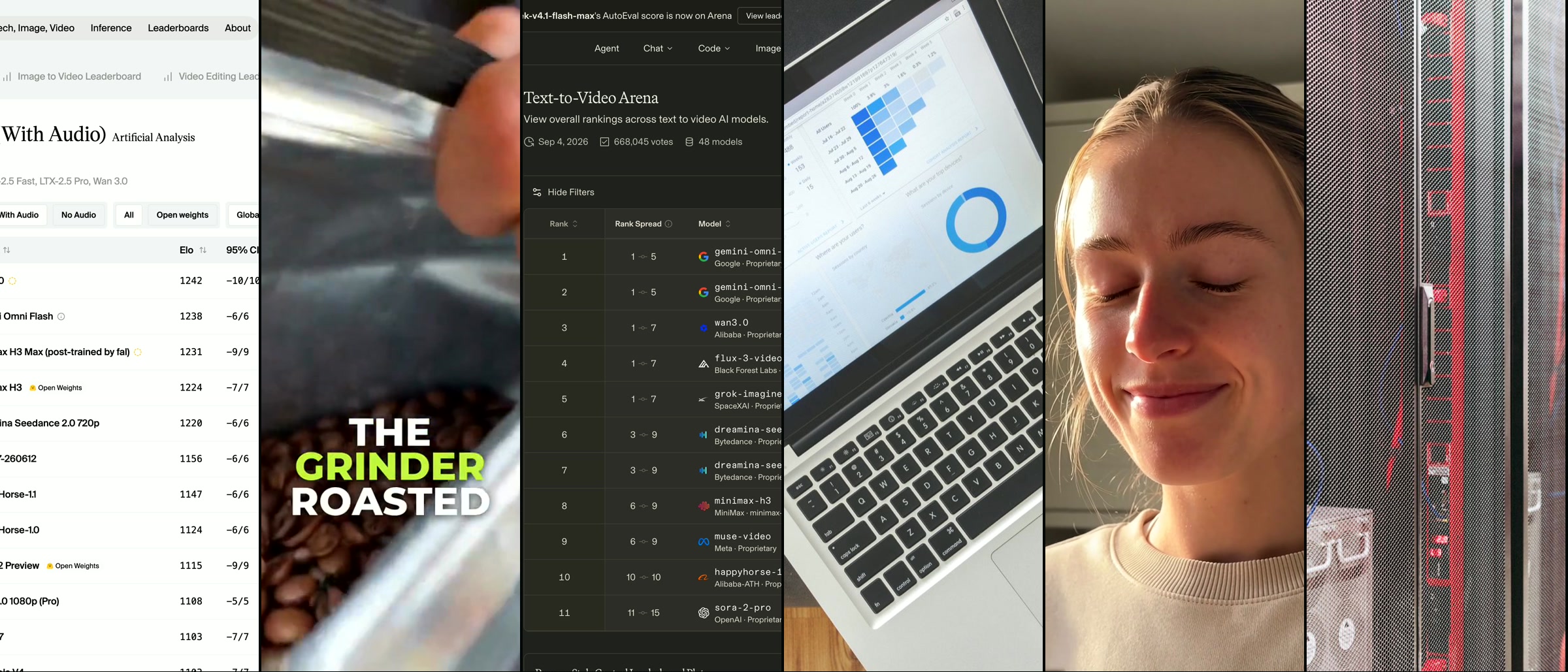
The Best AI Video Model for Ads in 2026: Five Boards, Four Winners
There is no single winner: run MiniMax H3 Max for cheap volume testing at roughly $8 of compute per finished 30-second spot on my own cost model, Gemini Omni Flash as the general default on Google's own recommendation, Kling 3.0 for multi-shot sequences and Seedance 2.5 for heavy product reference binding, because leaderboard rank barely predicts what survives a 30-second cut.
I checked five public rankings of AI video models on 10 September 2026 and got four different number-one models. Artificial Analysis has Wan 3.0 first at 1240 Elo with Veo 3.1 fifteenth, arena.ai has Gemini Omni Flash first on 668,045 votes, llm-stats has Kling v3 first on 1,394 votes, and Pixazo and FilmBench both put Seedance 2.0 first, at 1212 and 88.93, with Pixazo marking Veo down at 934.
Which model wins depends on the job. Run MiniMax H3 Max for volume testing at roughly $8 of compute per finished thirty-second spot, a figure from my own cost model further down rather than anything a vendor publishes, Kling 3.0 for multi-shot sequences, Seedance 2.5 for heavy product reference binding, and Gemini Omni Flash as the general default, which is Google's own documentation talking. Note the version gap before you buy: the two boards that crown Seedance are ranking 2.0, while the model I would put on a product shoot is the newer 2.5.
Retrieval note. Every price, rank and version number here was read on 10 September 2026 and decays in weeks. The reasoning outlasts the numbers.
Which AI video model is best for ads in 2026?
| The job | Model I would run | Why |
|---|---|---|
| Volume testing, many hooks a week | MiniMax H3 Max | $2.40 a minute, first on AA image-to-video |
| General default, text or image to video | Gemini Omni Flash | Google's docs name it the default, ~$0.10 a second |
| Multi-shot sequences with controlled cuts | Kling 3.0 | Per-shot timing and framing, per Kuaishou |
| A product that must not deform | Seedance 2.5 | 50 reference slots, strongest binding grammar |
| Talking-head UGC with native audio | Seedance 2.5 | Dialogue and lip-sync in one generation |
| Anything with a real person's face | None of them directly | See the face policy below |
| Scene extension or last-frame control | Veo 3.1 | Google reserves Veo for this |
| A spot whose client counsel reads the terms | Veo 3.1 | An output indemnity no rival here matches |
Why do AI video leaderboards disagree with each other?
All five were live on 10 September 2026. Read the sample column before the score column, and the interval before either.
| Board | Ranks first | Method | Sample | Veo 3.1 |
|---|---|---|---|---|
| Artificial Analysis, text-to-video with audio | Wan 3.0, 1240 | Paired-preference Elo | 5,733 samples, 95% CI published | 15th, 1091 |
| arena.ai, text-to-video | gemini-omni-1.1-flash, 1515 | Elo, blind pairwise, error bars | 668,045 votes, 48 models, 4 Sep | 12th, 1364 |
| llm-stats | Kling v3, 1934 | Scaled TrueSkill, mu minus three sigma | 1,394 votes, 12 models, 10 Sep | Not ranked |
| Pixazo | Seedance 2.0, 1212 | Proprietary Elo, in-house judge panel | 450 matches a track, 9 Sep | 934 |
| FilmBench | Seedance 2.0, 88.93 | 1,169 prompts, 20 genres, 35 sub-metrics, rho 0.95 | Nine models, 27 Jul | Third tier, around 81 |
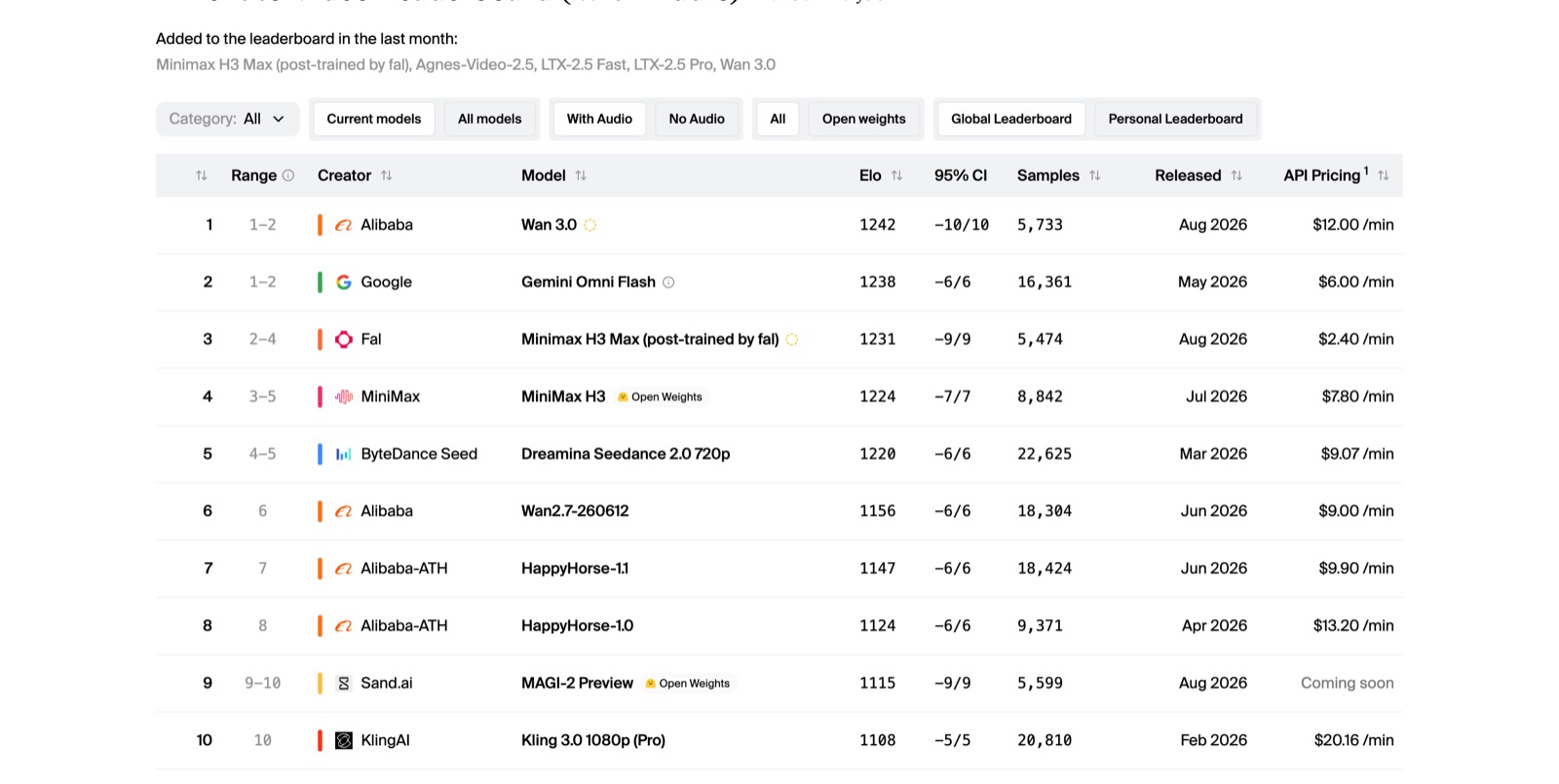
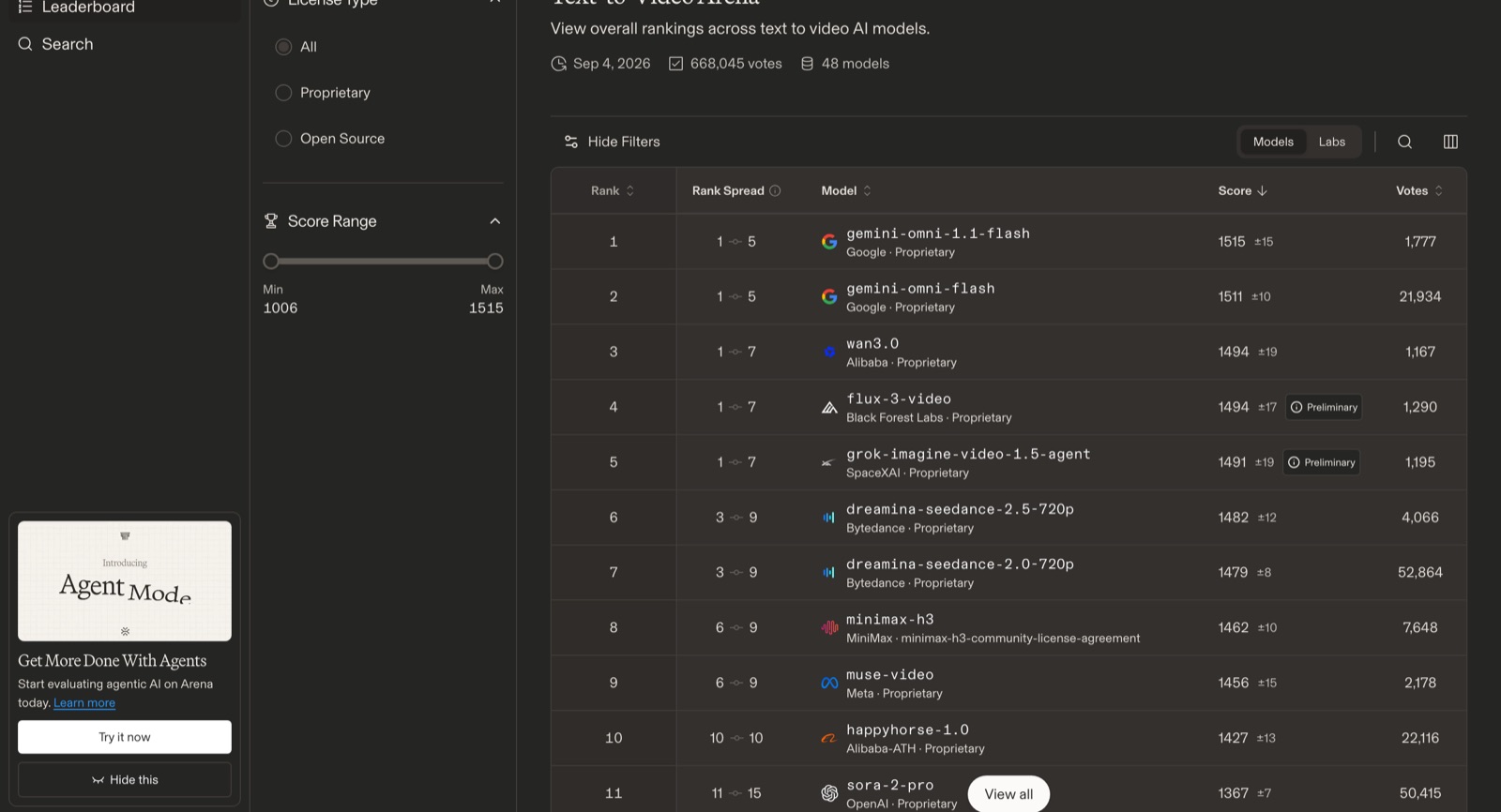
Two are too thin to argue with, llm-stats on about 116 votes a model and Pixazo selling API access to everything it ranks, while FilmBench is the only one scored against film-school criteria. Artificial Analysis does not even agree with itself: its image-to-video board has MiniMax H3 Max first at 1200 where its text-to-video board has Wan 3.0 first and MiniMax third.
arena.ai's top six sit at 1515±15, 1511±10, 1494±19, 1494±17, 1491±19 and 1482±12, an arbitrary ordering, and Artificial Analysis does publish an interval and a sample count, and reading them is what deflates its ranking: across its first through fifth at 1240, 1239, 1235, 1228 and 1222 the intervals overlap rank by rank, so the 18 points separating first from fifth are not a gap that survives its own error bars. Dehghani and co-authors called that the benchmark lottery in 2021.
Pages ranking for this query quote ranks that were never true. On 10 September 2026 Replicate called Runway Gen-4.5 "the top-rated video generation model, ranked #1 on the Artificial Analysis text-to-video benchmark" while Wan 3.0 held first, and others say Seedance 2.5 leads a board it is not listed on.
Does a higher leaderboard rank mean better ad creative?
A high rank tells you a model wins short close-up clips, which is not what an ad brief asks. More than 60% of arena test cases are portrait or talking-head prompts, per Wireflow's analysis, so a model tuned for faces wins a board built out of faces. "The Leaderboard Illusion" documents the same incentive on text models.
No board scores the multi-shot case, which is what two 2026 papers went after. FilmBench reports "a marked single- to multi-shot performance drop that widens for weaker models", 7.9 points on average, the strongest losing about 2.3 and the weakest as much as 22.8, and MovieGrid puts inter-shot consistency around 0.59 against intra-shot around 0.91 for its own method. Inside a shot, consistency is close to solved; the moment you cut, it comes apart.
How much does one 30-second AI video ad cost?
The generations-per-keeper ratio decides the invoice, and it varies by shot type more than by model. Poppify's breakdown is the best public version, on a vendor page with no method.
| Shot type | Generations per usable clip |
|---|---|
| Locked-off, single subject, no hands | 1 to 2 |
| Some camera movement or interaction | 3 to 5 |
| Hands, lip-sync, walking or multi-subject | 6 to 10 |
invideo sells an AI video product and has every incentive to talk waste down, so its own figures are worth reading. Its FAQ says roughly 25% of clips make the final cut and 10 to 40 prompts per usable clip is common, while its own four-ad run reports "108 images and 103 videos" for "49 used video clips", a "roughly 50% utilization rate", two vendor figures that disagree about the denominator.
PJ Accetturo has described the Kalshi NBA Finals spot as three days and about $2,000, per the reporting. The 300 to 400 generations for 15 usable clips circulating for that spot trace only to secondary coverage, so the 4% keeper rate is an anecdote.
Cost per finished second = (raw dollars per generated second ÷ keeper rate) ÷ edit retention rate. Both denominators are fractions below one, so a model at $0.10 a second with a 25% keeper rate and 60% edit retention costs $0.67 per finished second, nearly seven times the sticker price that every comparison table quotes on its own.
Cost per finished 30-second ad, modelled
Modelled on ten usable five-second shots at four generations per keeper, fifty seconds of keepers out of two hundred generated, cut to thirty with 60% edit retention baked in. Rates: Veo from Google's pricing page, Seedance at ModelArk's official rate via Cellcog, the rest from Artificial Analysis, and Kling is the one I could not confirm first-party.
| Model and tier | $ per second | Generations per keeper | Modelled cost, one 30s ad |
|---|---|---|---|
| MiniMax H3 Max | $0.04 | 4 | $8.00 |
| Veo 3.1 Lite, 720p | $0.05 | 4 | $10.00 |
| Gemini Omni Flash, 720p | $0.10 | 4 | $20.00 |
| Veo 3.1 Fast, 720p | $0.10 | 4 | $20.00 |
| Kling 3.0 Turbo | $0.11 to $0.14 | 4 | $22.00 to $28.00 |
| Wan 3.0 | $0.20 | 4 | $40.00 |
| Seedance 2.5, 720p, text-to-video | $0.2312 | 4 | $46.24 |
| Seedance 2.5, 720p, reference-heavy | billed at 2x | 4 | $92.48 |
| Veo 3.1 Standard, 720p/1080p | $0.40 | 4 | $80.00 |
Across comparable tiers the spread is 2x to 3x, reaching 10x only when a budget model meets a flagship tier, so pick the tier before the vendor. The "Veo costs ten times MiniMax" framing collapses on Google's own price list, where Veo 3.1 Lite sits within a rounding error of the cheap Chinese models.
Why the same model costs twice as much elsewhere
Seedance 2.5 at 720p runs from $0.2312 a second on ModelArk and Replicate to $0.4730 on fal, per Cellcog's cross-checked table, with WaveSpeed Turbo at $0.20 setting the floor and the 720p set spanning about 2.4x, so ten seconds of identical output costs $2.31 or $4.73 depending on where you bought it.
The formula matters more than the sticker. Seedance bills on `width × height × (input_video_duration + output_duration) × 24 / 1024` tokens, per apiyi's documentation, so a reference video's duration counts toward the bill even as an input, which is what doubles the reference row above.
Then there is the line nobody prices. One itemised sixty-second spot from AI Video Bootcamp, a course seller, so unaudited, comes to $229.80, where editing labour is the largest line at $100 or 43.5% against video compute at $72.00 or 31.3%. Nielsen put creative at 47% of sales lift against targeting's 9%.
AI video model comparison 2026: can it carry an ad?
Rates are official where a vendor publishes one and Artificial Analysis converted to seconds where none exists, all read on 10 September 2026, with anything I could not confirm marked n/a. I cut the release-date column I had been keeping, because I could not put a first-party announcement behind every row and a date I half-remember is worse than no date.
| Model and version | Max duration | Max resolution (API) | Native audio | Reference slots | Official $/sec | AA rank |
|---|---|---|---|---|---|---|
| Seedance 2.5 | 30s | 1080p | Yes | 50: 30 image, 10 video, 10 audio | $0.2312 at 720p | Not listed |
| Seedance 2.0 | 15s | 4K | Yes | 9 image, 3 video, 3 audio | ~$0.151 | 5th, 1222 |
| Gemini Omni Flash | 10s | 4K | Yes | Multi-turn conversational | ~$0.10 at 720p | 2nd, 1239 |
| Veo 3.1 | 8s | 4K | Yes | 3 "ingredients" | $0.40 std, $0.10 Fast, $0.05 Lite | 15th, 1091 |
| Kling 3.0 | 15s | 4K "in supported workflows" | Yes | Native multi-shot storyboard | n/a first-party | 10th, 1109 |
| Wan 3.0 | n/a | n/a | Optional | Frame conditioning, references | ~$0.20 | 1st, 1240 |
| MiniMax H3 Max | 15s | 2K | Yes | Omni-modal | $0.04 | 3rd, 1235 |
Duration, resolution and reference-slot figures come from the page each model name links to: fal's Seedance comparison for both Seedance rows, Google's Gemini API video docs for Gemini Omni Flash and Veo 3.1, Kuaishou's own model page for Kling 3.0 and the MiniMax H3 model card for H3 Max. Wan 3.0 carries n/a in both spec columns because I found no spec page I could cite for it, the same gap that leaves it without published weights below. AA ranks are from the text-to-video board.
Seedance 2.5, and the 4K claim that belongs to a different model
Is Seedance 2.5 native 4K? Not on any developer surface I could verify. Hosts expose 480p and 720p, 1080p arrived around mid-August, and nobody exposes 4K for 2.5 through an API. ByteDance shipped 2.5 and separately upgraded Seedance 2.0 to native 4K at the same 23 June 2026 announcement, and the English-language press ran the two together where Chinese coverage kept them apart.
ByteDance is not blameless: its consumer page is titled "Official Seedance 2.5: 4K & 30s AI Video Generator with Audio" while fal says 2.5 is 480p and 720p and 2.0 is the one doing 4K, and MindStudio still says 2.5 "adds 4K output resolution". Confirm on the surface you are buying before promising a client a resolution.
What 2.5 is genuinely good at is reference binding, 50 slots at 30 image, 10 video and 10 audio against 2.0's nine, three and three. Give each reference one job and forbid everything else. There is no `negative_prompt` field, and numbering follows upload order, so a wrong order binds the wrong image to the wrong job.
Seedance 2.5 costs more than every model I recommend except Veo 3.1, and it is slow in a way that matters on a call. Segmind measured wall-clock latency across five use cases at 60.1 to 226.7 seconds with a median of 138.9, and separately sent five identical ten-second requests that came back between 77.3 and 223.5 seconds, a 2.9x spread on the same prompt that rules out generating anything live in front of a client.
Gemini Omni Flash vs Veo 3.1, and the premium no leaderboard prices
Google's Gemini API documentation says to "Use Gemini Omni Flash as your default model for video generation" and to use Veo 3.1 where "scene extension, last-frame control, or integration with legacy pipelines are required", which is a cost and latency recommendation from the vendor and says nothing about quality.
What justifies Veo's price for brand work sits on no leaderboard: Google carries an output indemnity under its generative AI indemnified services terms, with a trademark carve-out that bites in advertising specifically, and no Chinese-hosted model offers an equivalent. On your own hooks take the cheap model; on a national spot the $60 you save is not what is being priced.
Kling 3.0, the multi-shot option
Kuaishou's own comparison page claims "multi-shot generation, custom shot timing, framing, angles and camera movement", with a Custom Multi-Shot mode where you "describe each shot separately and set its duration". It is a vendor page that never mentions Kling 3.0 Pro sitting tenth on Artificial Analysis, so take the product claims and ignore the ranking.
You can approximate it in Seedance by tiling one prompt with timecoded beats and explicit cut markers, with no documented parameter behind it, which is what the clip below does.
Wan 3.0 tops the biggest board and is not open source
Half the comparison pieces I read call Wan 3.0 open source, when as of 10 September 2026 I could find no weights and no inference code for it, and the Wan-AI organisation still shows Wan 2.2 under Apache 2.0 as the last open flagship. HappyHorse, seventh on the same board, gets called open source too, while fal, its API partner, states it will be closed, and MiniMax H3's weights need an application for the USA, EU, UK and South Korea.
MiniMax H3 Max, the cheapest credible option
At $2.40 a minute on Artificial Analysis, H3 Max is roughly a tenth of Veo 3.1 Standard and tops the image-to-video board, so volume testing is where I would spend it. Price the litigation alongside the $0.04, though: MiniMax is a defendant in Disney Enterprises v. MiniMax, No. 2:25-cv-08768, where on 22 May 2026 the court denied its motions to dismiss on both jurisdiction and the merits, the most consequential pro-plaintiff ruling yet against a video model maker.
The Sora API shutdown date is 24 September 2026
OpenAI notified developers on 24 March 2026, closed the consumer app on 26 April, and listed the Videos API and sora-2 for removal on 24 September with no recommended replacement. Wikipedia states OpenAI gave no reason, while trade coverage attributes it to compute reallocation. OpenAI had signed a three-year Disney deal in December 2025 covering more than 200 characters, then shut the product down inside a year anyway.
Gemini Omni Flash is the closest general replacement, and since prompt grammars are incompatible across these models, budget a rewrite of the prompt layer with any swap.
Five constraints that decide the model before quality does
- Who has to be told this is AI. AI Act Article 50 has bound EU audiences since 2 August 2026, with Article 99 penalties at EUR 15M or 3% of worldwide turnover, no grace period for advertisers, and provider-side marking under 50(2) running to 2 December 2026. Chinese-hosted models add CAC labelling from 1 September 2025, and three of my five picks are Chinese-hosted. FTC rules do not care that your customer is fictional, and Meta and Google penalise at account level.
- Can you upload a real actor's face? With Seedance, no: ByteDance blocks video made from images containing real faces, as its own BytePlus blog describes, while Google's and Kuaishou's terms restrict it short of a block. The sanctioned routes are likeness authorisation through the ModelArk console or a library of over 10,000 virtual human assets, so everyone shipping AI UGC builds a synthetic actor in an image model first.
- Will it render text you can legally ship? No model here reliably reproduces small legal copy, tight kerning or branded type, so composite brand assets in post over a clean plate.
- What happens when moderation rejects a generation you already paid for? Segmind saw requests naming specific film stocks or branded looks rejected after generation completed, a cost no comparison prices.
- Can you get the weights? Not for Wan 3.0 or HappyHorse, and MiniMax H3 needs a filed application, so the top of the most-cited leaderboard is closed to self-hosters.
Does using AI video hurt ad performance?
Exner, Hartmann, Netzer and Zhang's study of 4,633 sibling ads across 369 million impressions found AI and human creative at parity once you control for campaign, with the penalty attaching to images that read as AI rather than to images that are AI, at a looks-like-AI coefficient of -0.3759 uncontrolled and -0.3468 with full controls, in a working paper awaiting peer review and covering images, with intense colour saturation as its one actionable cue.
The demand side points the other way: an NYU Stern finding in the IAB's framework puts the click-through cost of an AI label at 31.5%, Gartner's survey of 1,539 US consumers found half preferring brands that avoid generative AI, and Coca-Cola's 2025 AI Christmas ad drew the year's loudest backlash while System1 scored it 5.9 stars on its own instrument. Model choice solves none of it, which I unpack in why ads that look AI-made underperform ads that are AI-made.
One model or several, and what I would run next week
Run two models across the funnel and keep them out of the same cut, the cheap one for concept testing where the footage is disposable and the expensive one for the winner, regenerated end to end. Never intercut two vendors inside one spot, because no reference system carries across models, so skin, colour science and grain fail to match and the grade costs more than the compute you saved by mixing them.
For a spot next week I would storyboard in stills and get sign-off before a render exists, which alone moves generations per keeper from roughly ten to four in my runs. Draft at 480p, about 0.44 times the price of 720p on the official rate card, approve at 720p, change one variable per retry, and run the frozen-frame QA from my checklist for catching AI tells before anything ships.
Frequently asked questions
What is the best AI video generator for ads in 2026?
There is no single winner, though the split is defensible: MiniMax H3 Max for cheap volume testing, Gemini Omni Flash as the general default on Google's own recommendation, Kling 3.0 for multi-shot sequences, and Seedance 2.5 when heavy product reference binding matters. Pick on whichever constraint binds your brief and ignore the rank.
Is Seedance 2.5 really native 4K?
Not on any developer surface I could verify: hosts expose 480p and 720p, 1080p arrived around mid-August 2026, and the native 4K upgrade announced at the same June 2026 event went to Seedance 2.0. ByteDance's consumer page still advertises 4K for 2.5.
Which AI video model has the best native audio and lip sync?
Seedance 2.5, because dialogue synthesises and lip-syncs in the same generation with no separate TTS pass. I have only run it in English, so treat its other languages as untested here. MindStudio documented phoneme corruption in both 2.0 and 2.5, with "I know" rendering closer to "I low", so listen to every line before it enters the edit.
Is Wan 3.0 open source?
No. As of 10 September 2026 I could find no published weights, inference code or ComfyUI node for Wan 3.0, despite it topping the Artificial Analysis text-to-video board. I checked Hugging Face and not ModelScope, where Alibaba often publishes first, so check both before planning a self-hosted deployment.
When does the Sora API shut down?
24 September 2026, the date OpenAI lists for removing the Videos API and sora-2. It notified developers on 24 March 2026 and closed the consumer app on 26 April, with no recommended replacement listed and no reason given in the notice.
Keep reading
How to Use Seedance 2.5 for Ads Without Burning Credits
How to use Seedance 2.5 for ads: the real resolution ceiling, what each of the four modes actually bills on, and the prompt grammar that stops cuts morphing.
AI Ads That Don't Look AI-Generated: The Evidence and the Recipe
AI ads that don't look AI-generated hit parity with human ads in a 369M-impression field test, and only the AI look costs clicks. Evidence, recipe, costs.
Why UGC Ads Beat Polished Video Ads
Phone-shot creator ads outperform studio video on nearly every paid metric. Here's what the numbers actually say, who published them, and where the advantage stops.
How Many Ad Creatives Should You Actually Test?
Only 4-8% of Meta ads become winners, and the median advertiser ships 6-7 a week. Run the arithmetic on what that means for a brand shipping one video a month.